
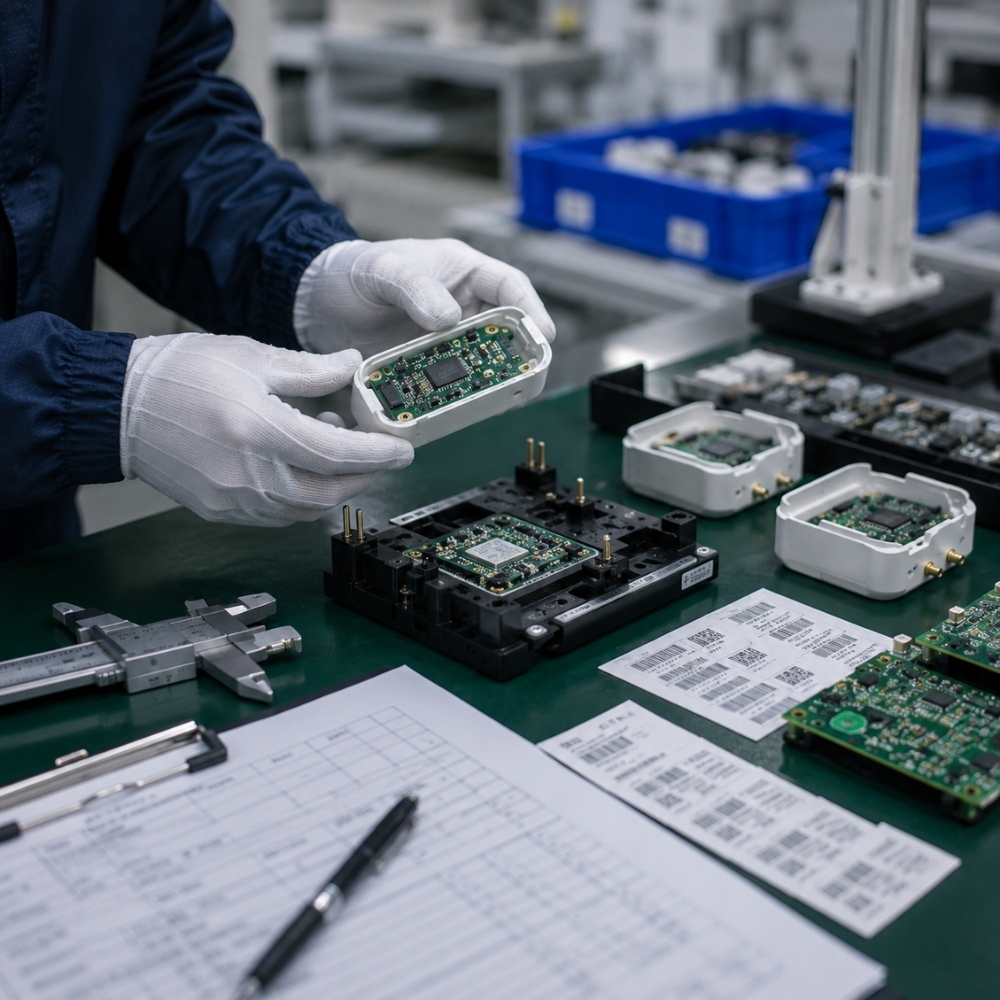
Standardized quality management for startups
From proactive quality management to advanced reliability testing and global certification support, we empower your products to meet the highest standards of performance and compliance. Our integrated approach minimizes risk, accelerates time to market, and ensures your devices are built to endure — wherever they’re deployed.
Setting Appropriate Quality Standards
Key components of IoT hardware include: processor, sensors, communication modules, memory/storage, power supply, and external interfaces such as display, camera, and speaker.
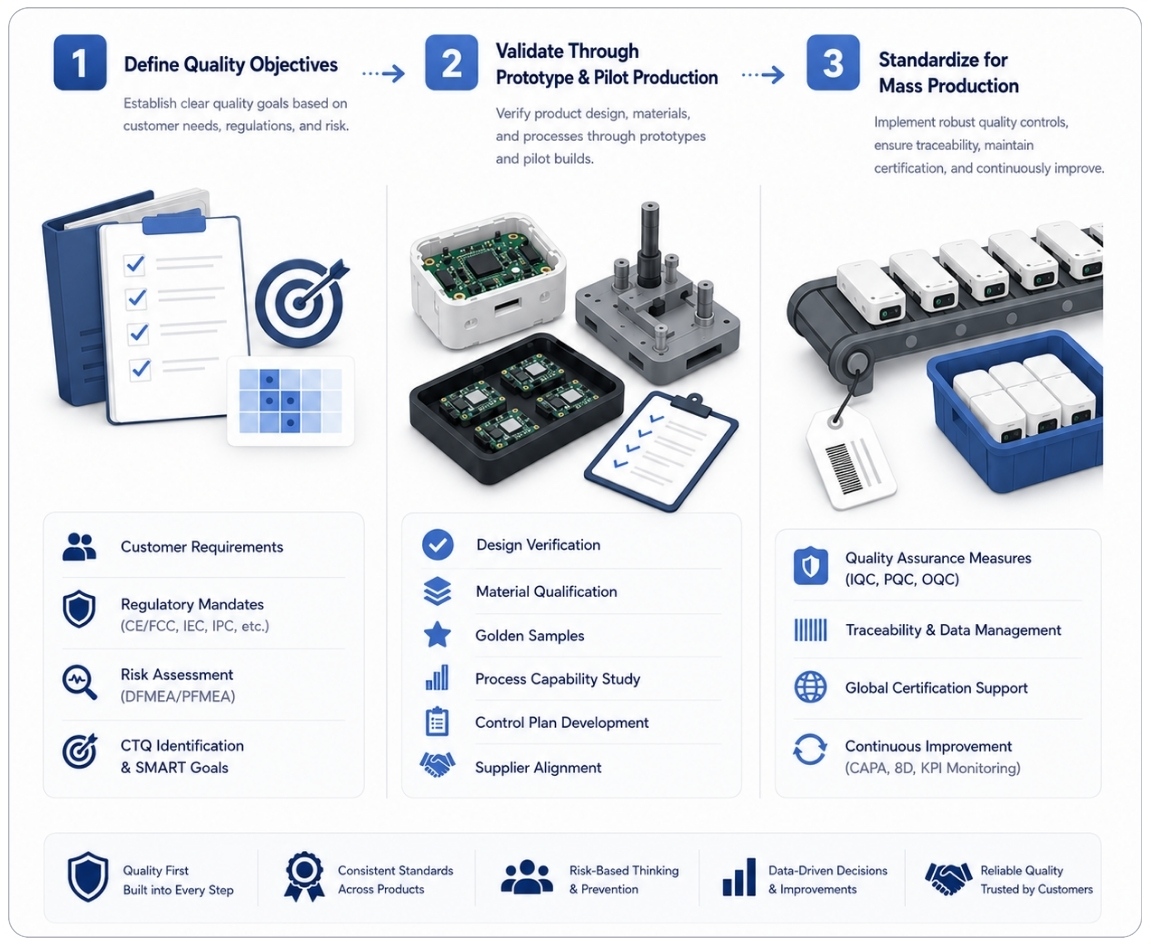
End-to-End Quality Management Process
Our quality management capabilities are designed to drive both performance and trust. By integrating risk control, precision monitoring, and continuous improvement across every stage of the product lifecycle, we ensure your IoT innovations are reliable, compliant, and ready to scale with confidence

Supplier evaluation
Ensure suppliers meet quality, delivery, and cost requirements through ISO 9001/IECQ QC 080000 audits and performance monitoring (defect rates, on-time delivery). Continuously assess compliance to drive supplier accountability.
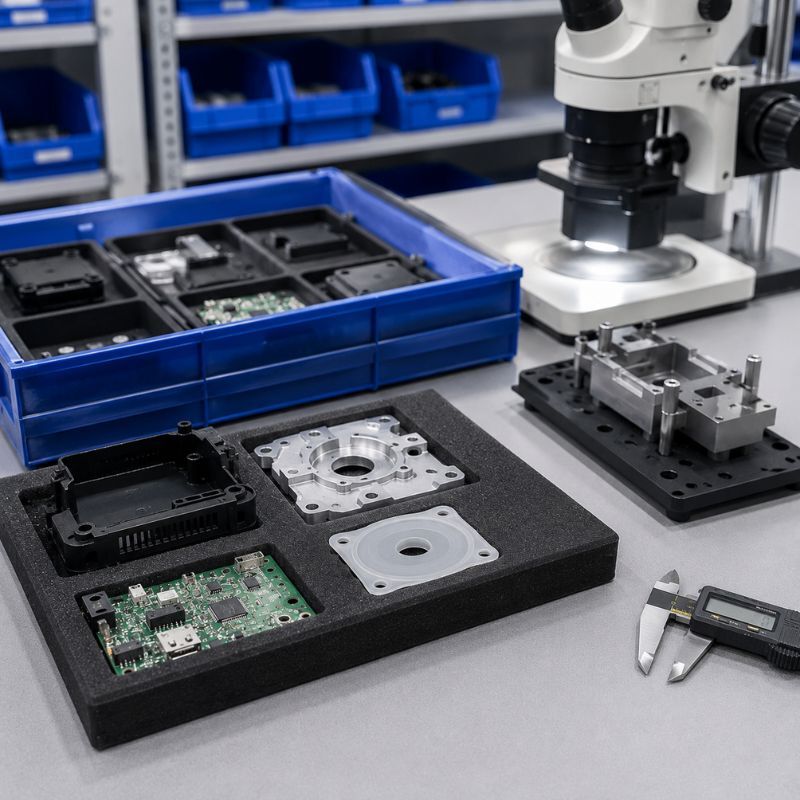
Engineering sample management
Validate design feasibility via a 4-stage workflow (sample submission, testing alignment, cross-functional review, approval/revision), using golden samples as benchmarks to ensure production consistency and alignment with specifications.
.jpg)
Incoming quality control (IQC)
Prevent defective materials from entering production by verifying golden samples, conducting dimensional checks via CMM, and implementing AQL-based sampling to prioritize critical inspections.
.jpg)
Process Quality Control (PQC)
Maintain manufacturing consistency through SPI, SMT reflow profile verification, X-ray inspections for key ICs, and ICT first-piece validation to detect deviations in real time.
.jpg)
Outgoing inspection control (OQC)
Guarantee product compliance by executing 100% functional testing (e.g. firmware validation, Software-based functional testing) prior to shipment, ensuring adherence to customer specifications.
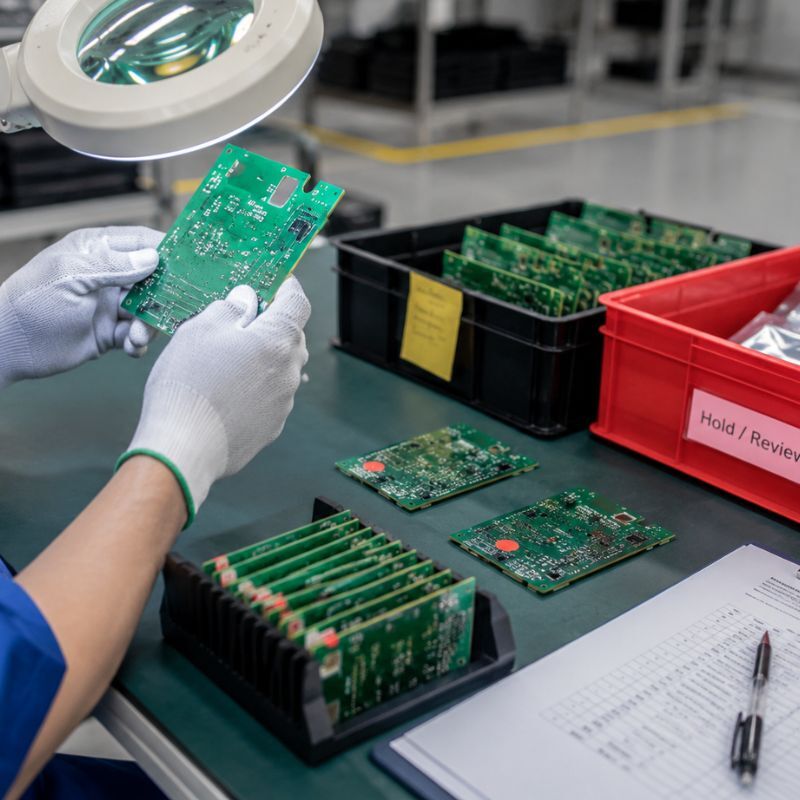
Nonconforming product management
Isolate defective items using batch management, perform root cause analysis (8D/5Whys), and implement corrective actions (process recalibration, retraining) to prevent recurrence.
Customer complaint management
Resolve issues swiftly via a 24/7 complaint portal with automated escalation, cross-functional RCA teams, and closed-loop feedback to update FMEA databases and refine design guidelines.
Reliability Testing
Our reliability testing capabilities are engineered to reveal hidden risks and strengthen product integrity. By simulating real-world stressors through advanced testing aligned with global standards, we help you uncover failure points early, optimize durability, and reduce field failures — turning reliability into a measurable advantage for your IoT innovation.

Temperature Cycling Test (-40°C to +85°C)
Validates material stability and thermal expansion resistance for automotive electronics, aerospace components, and outdoor IoT sensors exposed to extreme environmental shifts.

IP67/IP68 Water & Dust Resistance
Certifies sealing integrity against liquid ingress (1m submersion) and particulate contamination for smartwatches, industrial field devices, and outdoor security cameras operating in harsh conditions.

Vibration Testing
Evaluate the product’s ability to withstand mechanical stresses caused by vibrations during transportation, operation, or environmental exposure for vehicle-mounted electronics, machinery controllers.

Mechanical Fatigue Testing
Evaluates endurance under repetitive stress (e.g.button presses, connector mating cycles) for consumer USB ports, medical devices, and wearable hinges.

UV Resistance Testing
Measures degradation under accelerated UV exposure to ensure longevity of outdoor signage, solar devices, and automotive exterior parts.

Drop Test (1.5m Multi-Angle)
Simulates real-world drops to verify structural integrity in smartphones, handheld scanners, and portable medical tools.

Melt Flow Index (MFI) Test
Quantifies polymer flowability for IoT housing material selection and raw material QC (PC, ABS, nylon) to ensure manufacturing consistency.

Abrasion Resistance Test
Validates surface durability against friction for touchscreens, keypads, and wearable interfaces prone.

Tensile Test
Determines mechanical strength and elongation for structural components like plastic clips and cable connectors.

Neutral Salt Spray (NSS) Test
Evaluates corrosion resistance for marine equipment, automotive parts, and coastal sensors in salt-rich environments.
Professional Laboratory Partnerships for Global Certification
NexPCB accelerates market access in Europe, North America, Asia, and beyond through accredited partnerships with SGS, CTI, and IoT protocol bodies (Bluetooth SIG, Wi-Fi Alliance).
Leveraging pre-validated design reviews and direct lab submissions, we slash 50% off certification timelines — ensuring your IoT devices meet global standards and end-user durability demands in one streamlined workflow.
.png)
.png)
.png)
.png)
.png)
Laboratory Partnership
.png)
.png)
.png)
.png)
.png)
.png)