





Capabilities

A proven stage-gate roadmap that coordinates every engineering function from first sketch to global volume without losing momentum.

Get My Roadmap Get a Quick Estimate
Trusted by:
image 89 image 90 image 92 image 93 image 94 image 95 image 89 image 90 image 92 image 93 image 94 image 95
What is the Next Stage Framework?

A single roadmap, every function, every stage.

Most hardware startups fail not because of bad ideas — but because of coordination gaps between development phases. Engineering hand-offs get lost. Quality enters too late. Tooling decisions are made without manufacturing input. The Next Stage Framework (NSF) is NexPCB's answer: a two-dimensional matrix that maps every functional team (EE, ME, FATP, Logistics, SCM, PM, QA) against every product stage (S0–S6), making involvement expectations explicit from day one. Every cell in the matrix is an intentional decision — not a default.

7
Product Stages (S0–S6)
7
Functional Teams
<1mo
Prototype to Shipment
50%
Faster Certification
S0

Design

Concept Development

S1

EVT

Engineering Validation Test

S2

DVT

Design Validation Test

S3

PVT

Production Validation Test

S4

Ramp-Up

Production Ramp-up

S5

Volume

Volume Production

S6

SCM & EOL

Supply Chain Management & End of Life

Design VALIDATION VALIDATION PRODUCTION PRODUCTION SCALE SCALE
EE Electrical Engineering
ME Mechanical Engineering
FATP Final Assembly, Test & Pack
Logistics Logistics & Distribution
SCM Supply Chain Management
PM Project Management
QA Quality Assurance
Engineering Depth (EE, ME, FATP, SCM, Logistics)
▲
PM Coordination Load
▲
QA Gate Intensity
● ▲ . ▲
Critical Node

7 Functional Teams

Each function operates with full domain depth. NSF tells them exactly when to engage at full intensity, when to support, and when to hand off — eliminating wasted effort and missed inputs.

Electronics Engineering

Electronics Engineering

PEAK S1 S2 S3

The electronics backbone — from PCB stack-up and RF design to certification and production firmware. Deep engagement through prototyping and pilot, with a critical gate at NPI tooling for certification filing.

RF Technologies: BLE, LTE, WiFi, GNSS, LoRa, etc.
Electrical Signal Conversion: 
ADC (Analog to-Digital Converter)
Power Management: PMIC, Lithium, Battery Technology
Processors: 
 MCU, Processor Modules
Display Technology: Optical Modules, MicroOLED, MicroLED
  • PCB fabrication up to 68 layers, 3 mil trace
  • BGA assembly, X-ray, SPI & ICT inspection
  • Rigid, Flex & Rigid-Flex, HDI
  • Pre-compliance through FCC/CE certification
  • Firmware bring-up & embedded testing
View EE Capabilities

Mechanical Engineering

PEAK S1 S3 NPI LOCK

From FDM prototypes to automotive-grade injection molds. ME is deep at prototyping, transitions to support at pilot, then peaks again at NPI tooling lock — the critical moment when all tooling decisions become permanent.

CNC: Ti, Al, Cu, Wood, SS, Plastic
Silicone Molding: ABS-like, PU
Injection Molding: Plastic, Metal
Double-Shot & Over Molding: Rigid-Flex
Casting: Aluminum alloy, Magnesium alloy, Zinc alloy
  • Sheet Metal Fabrication
  • 3D Printing: Transparent material, Reinforced Nylon
  • Others: Laser cutting, Painting, Silkscreen
  • 40+ materials, ±0.05mm tolerance
View ME Capabilities

Final Assembly, Test & Pack

PEAK S3 S4 DEPLOYMENT

FATP inputs begin at S1 to prevent costly rework later — but full deployment is at S3 (line design lock) and S4 (volume throughput). This team owns the assembly line, jigs, test stations, and packaging operations.

Assembly line design & takt time optimization
Jig & fixture fabrication
100% functional test station design
Packaging design, materials & labelling
View Assembly Capabilities

Project Management

PEAK S0–S2 TAPERS TO S5

PM is intentionally heaviest at the beginning — where coordination complexity is highest — and tapers as the product matures into stable production. PMP® certified managers use Gantt charts, Basecamp, and control books to maintain transparency.

PMP® certified project coordination
Gantt chart & milestone planning
Real-time Basecamp project tracking
Cross-functional escalation management
IP protection under US NDA
Explore Project Support

Quality Assurance

PEAK S1 GROWING TO S6

Unlike all other functions, QA does not taper — it builds. Coverage is minimal at prototyping (golden sample creation) and reaches full deployment at volume production with 100% OQC functional testing before every shipment.

Five-stage quality management: Supplier Evaluation → Engineering Sample Management → IQC → PQC → OQC
ISO 13485 & ISO 9001 & IECQ QC 080000 audits
AQL-based sampling, CMM dimensional checks
Reliability: −40°C to +85°C, drop, IP, salt spray
8D / 5-Whys structured root cause analysis
View QA Capabilities

Supply Chain Management

PEAK S0 THROUGH S6

SCM is active across every stage from early BOM feasibility at S0 to end-of-life phase-out at S6. The core mission: consistency, cost effectiveness, and quick response through tariffs, shortages, and shifting demand.

Multi-region manufacturing
Multisourcing for risk & cost optimization
Strategic stocking & fixed-price locking for long-lead components
Demand-cycle & seasonal production planning
Multimodal logistics (air, rail, marine)
  • Buffer stocking in strategic warehouses
  • Component lifecycle & EOL management
  • Tariff strategy & import/export support
View SCM Capabilities

Logistics

PEAK S4 S6

Logistics starts small and scales with volume. During prototyping and pilot builds it mostly means fast express shipments of samples and golden units. As the product moves into volume production, it becomes a full supply-chain function, with multimodal freight, regional warehousing and customs compliance planned around your launch dates and landed cost.
Air, ocean, rail & ground freight via DHL, FedEx, UPS & EMS
Warehousing: Hong Kong, Indonesia, Vietnam, Eastern & Western US
Localized last-mile delivery support in the United States
Shipping strategy: routing, consolidation & incoterm planning
Certificate of Origin, battery certification (UN38.3 / MSDS) & cargo insurance
The Philosophy

Built on four  founding principles

NSF is not just a project management tool. It reflects how NexPCB believes hardware should be built — with intentionality at every cell of the matrix.

01
Stage aware engagement

Every function has a different role at every stage. Being "always on" wastes resources and creates noise. NSF defines exactly when each expert should be at full intensity and when to step back.

02
Quality built In, not bolted on

QA is not an end-of-line check. It begins at S1 and grows continuously. Problems caught at S1 cost dollars; the same problems at S4 cost weeks and thousands. NSF structures QA involvement to prevent regressions.

03
Front-loaded risk reduction

S0 and S1 exist to make S3 — the most expensive stage — safe. DFM analysis, material selection, supplier qualification, and architecture reviews at S0 are investments that pay back exponentially at NPI tooling lock.

04
Transparent, single-partner execution

Fragmented vendors create hand-off gaps. NexPCB's integrated EE, ME, FATP, QA, and SCM teams share one framework, one communication platform, and one accountability structure — from first schematic to last shipment.

Bring NexPCB Expertise to Your Business

Let's Discuss Your Project

Get My Roadmap NDA Template
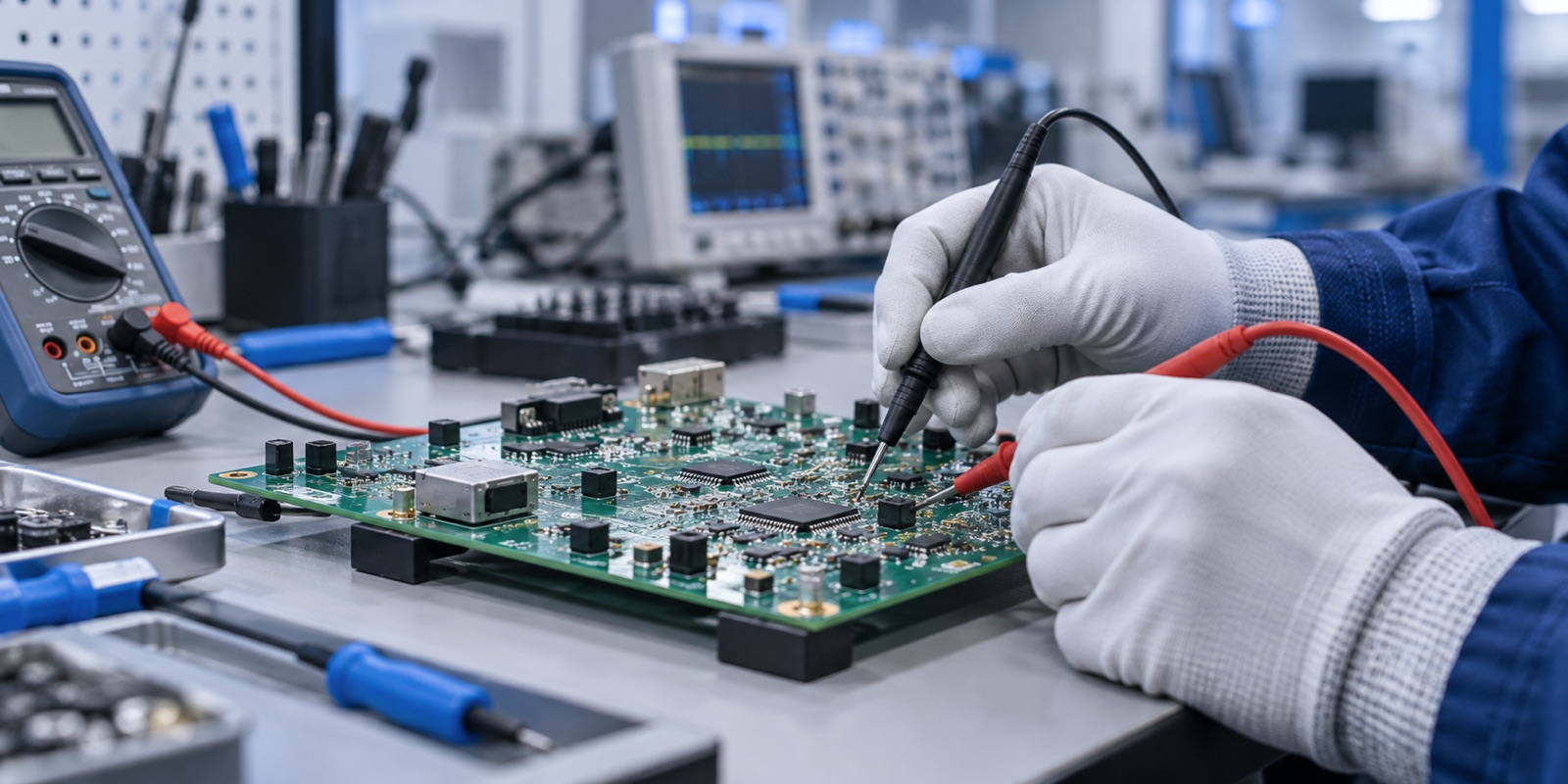
PCB validation and quality testing