
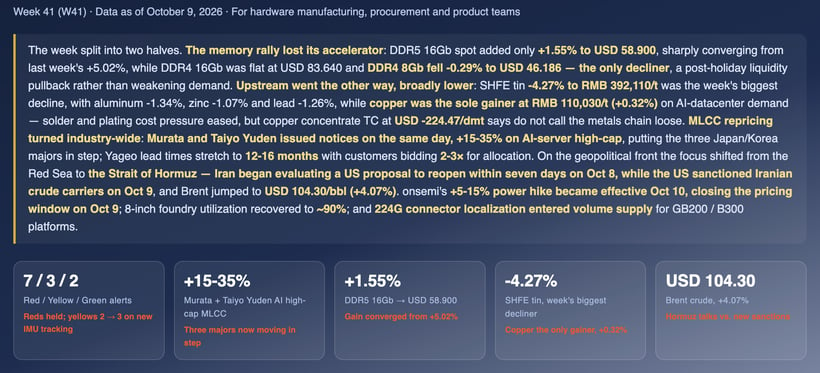
1. Week-over-Week Comparison — Segment Changes & Drivers
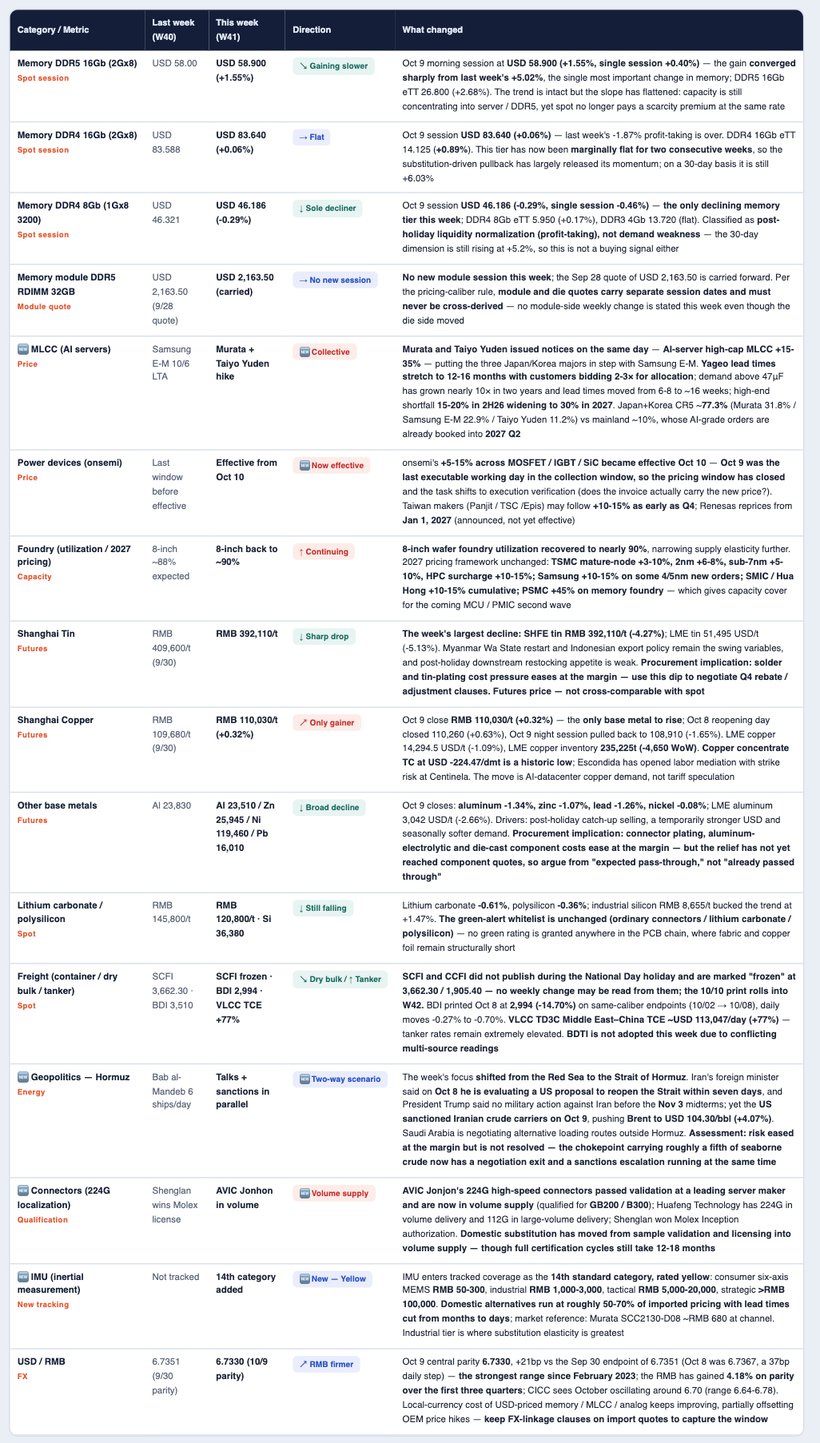
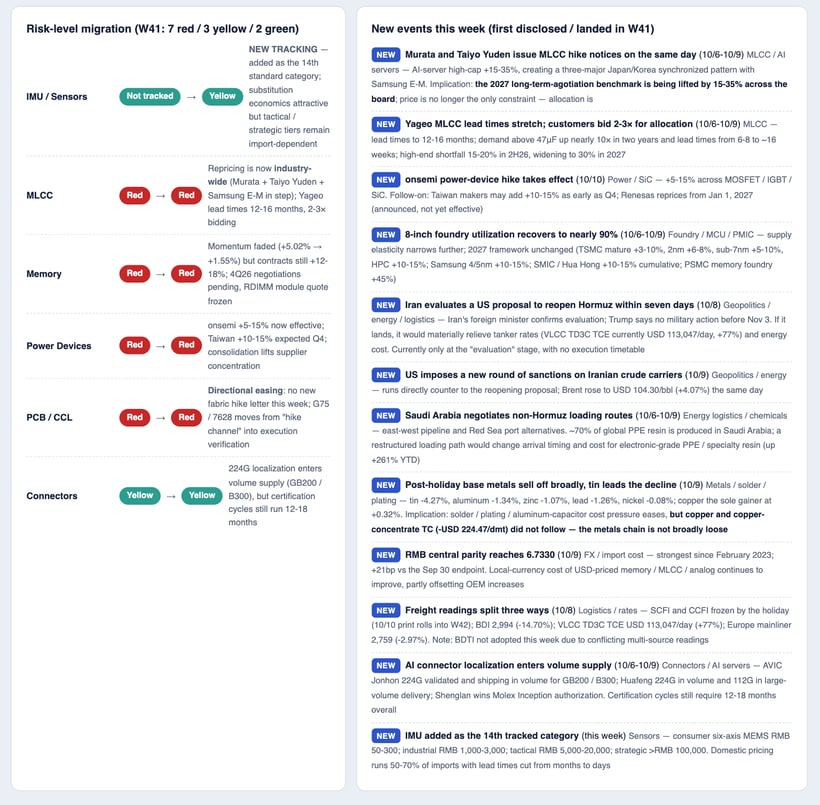
Comparison window: W40 (2026.09.25–10.02) vs W41 (2026.10.02–10.09). Sixteen categories / metrics moved materially; risk rating holds at 7 red but yellows rise from 2 to 3 as inertial measurement units (IMU) enter tracked coverage for the first time. The week's defining feature is divergence — memory momentum fading while post-holiday base metals ease broadly, against an MLCC repricing wave that just turned industry-wide.
2. Five Forces Driving the Market This Week
- MLCC repricing goes industry-wide
Murata and Taiyo Yuden both moved on the same day — AI-server high-cap +15-35% — so the three Japan/Korea majors are now repricing in step. Yageo lead times at 12-16 months; high-end shortfall 15-20% in 2H26, 30% in 2027. - Memory momentum fades, not reverses
DDR5 16Gb +1.55% vs +5.02% last week; DDR4 16Gb flat; DDR4 8Gb -0.29%. Spot slope flattens while 4Q26 contracts still guide +12-18% — contract cost does not follow spot downward. - Metals diverge: copper strong, rest soft
Tin -4.27%, aluminum -1.34%, zinc -1.07% — solder and plating relief. But copper +0.32% on AI demand, concentrate TC at USD -224.47/dmt, Escondida mediation live. Do not generalize "metals are loose." - Hormuz replaces the Red Sea as the focus
Iran evaluating a 7-day reopening proposal (10/8) while the US sanctions Iranian crude carriers (10/9); Brent USD 104.30 (+4.07%). A chokepoint carrying ~a fifth of seaborne crude now runs negotiation and escalation simultaneously. - Pricing windows close; 2027 cost center rises
onsemi's window closed Oct 9 and its hike is live; 8-inch utilization back to ~90%; TSMC 2027 mature +3-10%, 2nm +6-8%; SMIC / Hua Hong +10-15% cumulative. Supply elasticity is narrowing across mature nodes.
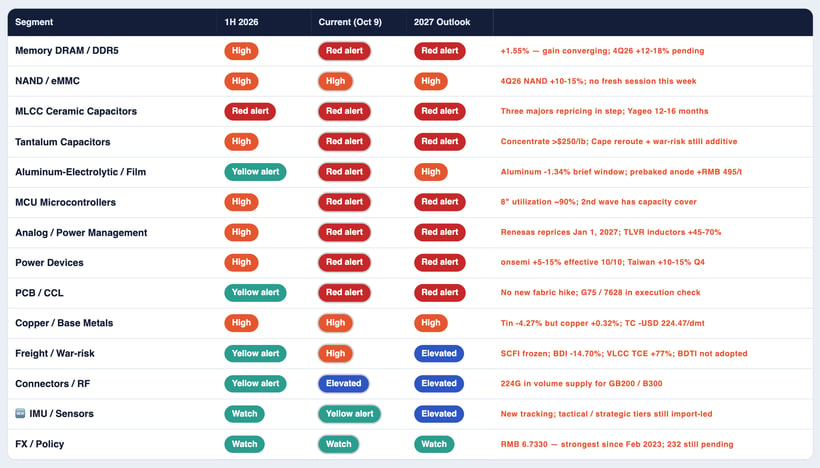
3. Risk Heat Map — 14 Segments × Three Time Windows
Color block = supply / price tightness. Bold outline = moved this week. Red = rising / high risk, green = falling / loose supply-demand (China market convention). IMU is new this week, entering at yellow alert.
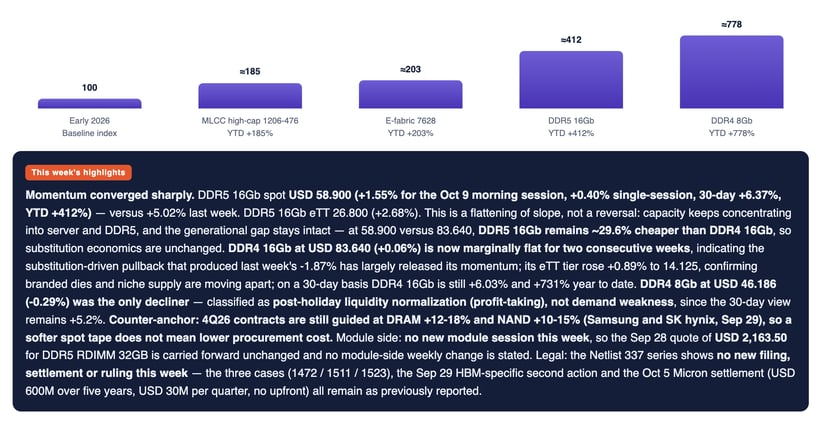
4. Memory — The Rally Keeps Its Level but Loses Its Slope
The week's message is about rate of change, not direction: DDR5 16Gb spot added only +1.55% to USD 58.900 versus +5.02% last week, DDR4 16Gb was flat at USD 83.640, and DDR4 8Gb slipped -0.29% to USD 46.186 as post-holiday liquidity normalized. Meanwhile the RDIMM 32GB module quote had no new session and carries forward at USD 2,163.50 — module and die quotes remain separate series and must not be cross-derived.
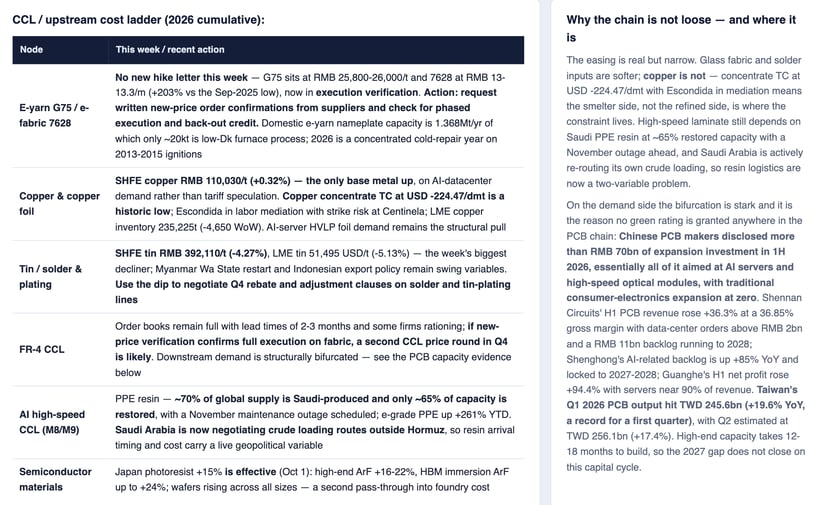
5. PCB & CCL — No New Fabric Hike, but Copper and Tin Split, and the Chain Is Not Loose
Directionally this is an easing week for the glass chain — no new e-yarn or e-fabric price letter after last week's +30% jump, which moves from "hike channel" into execution verification. But copper rose while tin fell 4.27%, so the metals chain is diverging rather than loosening, and high-speed laminate still carries a resin-side geopolitical exposure.
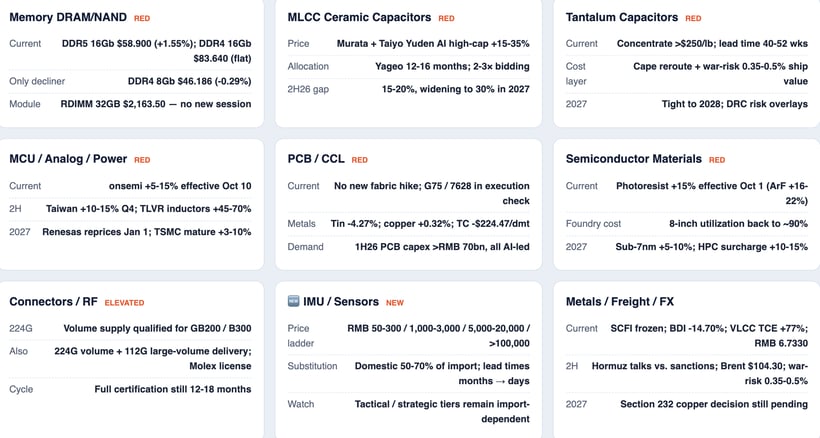
6. Segment Snapshot
7. This Week's Procurement Playbook — What to Do Now
Standing section, rewritten each week for the changes. Pull-in strategy runs parallel to cost-down / substitution paths.
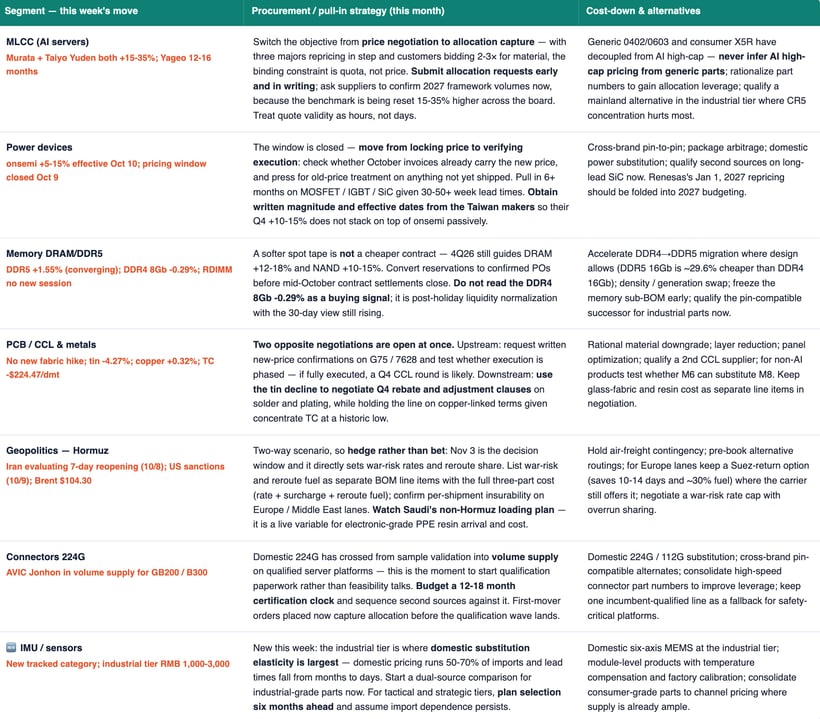
Substitutes typically need a 6-12 week qualification cycle (12-18 months for high-speed connectors on qualified server platforms). Our market-intelligence team maintains a cross-category pre-qualified substitute list — the qualification clock is already running, see §11.
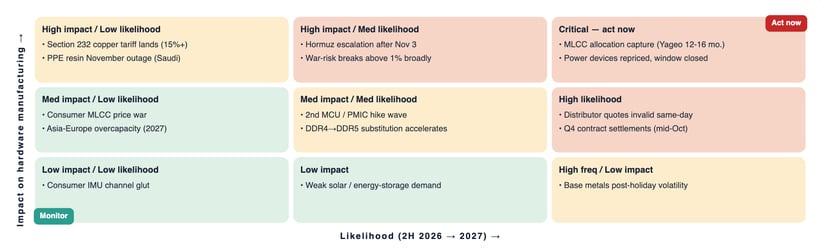
8. Risk Matrix — Likelihood × Impact
Attention allocation: act immediately in the top-right, monitor continuously in the bottom-left.
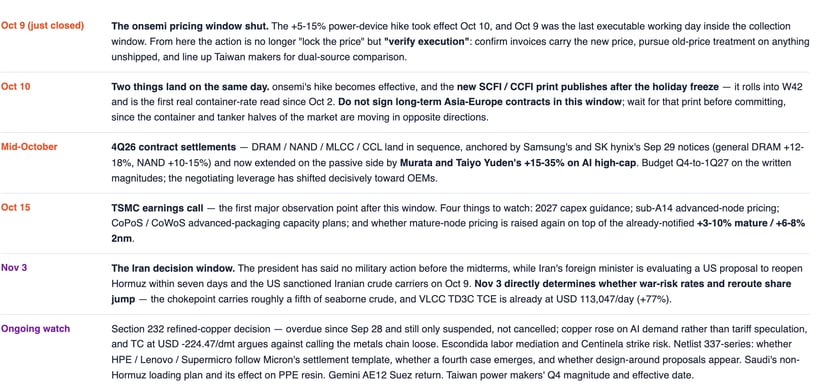
9. Decision Timeline — Near-Term Windows & Key Nodes
10. Two Scenarios into 2027
Base case — momentum cools, cost stays high
- Memory spot flattens as it did this week while contracts settle at +12-18%: the plateau holds but does not reverse, and procurement cost stays high even where spot looks soft. Spot and contract diverge for the rest of 4Q26.
- MLCC repricing passes through once as the three majors synchronize, and allocation — not price — becomes the standing constraint into 2027; high-end shortfall of 15-20% in 2H26 widens to 30% in 2027.
- Post-holiday metals relief persists in tin and aluminum while copper holds on AI demand; solder and plating costs ease without reaching component quotes, giving buyers a narrow but real negotiating window on adjustment clauses.
- Iran's Hormuz evaluation produces no timetable and the Nov 3 window passes without military action; war-risk holds at 0.35-0.5% of ship value with Bab al-Mandeb transits stuck near 6 ships/day.
Stress case — geopolitics and materials compound
- Talks collapse into escalation after Nov 3: sanctions tighten, Brent extends its move past USD 104.30/bbl, and rerouting costs stack on an already-elevated VLCC TCE of USD 113,047/day. Saudi's alternative loading routes fail or are delayed, and the ~70% of global PPE resin produced there stays at partial capacity through the November outage — which would push high-speed laminate into a genuine full-chain cost shock for the first time this cycle.
- A second MCU / PMIC wave lands into 8-inch utilization at ~90%, so foundries have no slack to absorb it; that meets TSMC's 2027 mature +3-10% and SMIC / Hua Hong's cumulative +10-15%, pushing analog, MCU and power costs up again in 1H27.
- MLCC allocation tightens past 2-3× bidding into outright shortage, and the 12-16 month lead times already being quoted make any 2027 capacity booking a race — while a foil / copper squeeze meets concentrate TC at a historic low.
What smart buyers are doing right now
- Switch MLCC tactics from price negotiation to allocation capture — with three majors repricing in step and customers bidding 2-3×, quota is the constraint, not price.
- Do not read a softer memory tape as cheaper procurement: 4Q26 contracts still guide +12-18% even with DDR5 spot up only +1.55%.
- Run two metals negotiations in parallel — press for Q4 rebates on the tin decline while holding copper-linked terms, since concentrate TC at USD -224.47/dmt says the chain is not loose.
- The onsemi window closed Oct 9 — shift the whole power conversation to invoice-level verification and get written magnitudes from the Taiwan makers before their Q4 hike stacks on.
- Treat Nov 3 as a binary node, not a background risk: hedge Hormuz exposure rather than betting on either the talks or the sanctions.
- Start 224G connector qualification paperwork now — domestic supply is already in volume on qualified platforms, and the 12-18 month certification clock is what actually determines your 2027 position.
Get ahead of the next step-change
Book a supply-chain acceleration review and we'll map your exposed BOM lines against this week's moves — and put pre-qualified alternates and buy-ahead options on the table.


.png)