
During an early production build, several wearable units powered on, connected, and passed basic functional checks—but their optical readings were lower than those from the validated prototype.
The PCBAs were functional. Firmware loaded correctly. The mobile connection and cloud dashboard worked. Yet the sensing output had shifted between the prototype and production builds.
The strongest lead was a part that could easily be mistaken for enclosure trim: the coated window between the sensor and the wearer’s skin. A same-device swap, independent spectral testing, and supplier process review all pointed to coating-lot variation.
Why wearable sensor problems cross disciplines
Wearable product development compresses several interacting systems into a body-worn enclosure. Signal quality can depend on:
- LED output and wavelength
- Photodiode sensitivity and analog front-end behavior
- Firmware, calibration, and data-refresh logic
- Skin contact, motion, optical alignment, and stray light
- Window material, coating, thickness, assembly, and sealing
A board-level test can confirm that the electronics are alive. It cannot prove that the complete optical path is performing as designed.
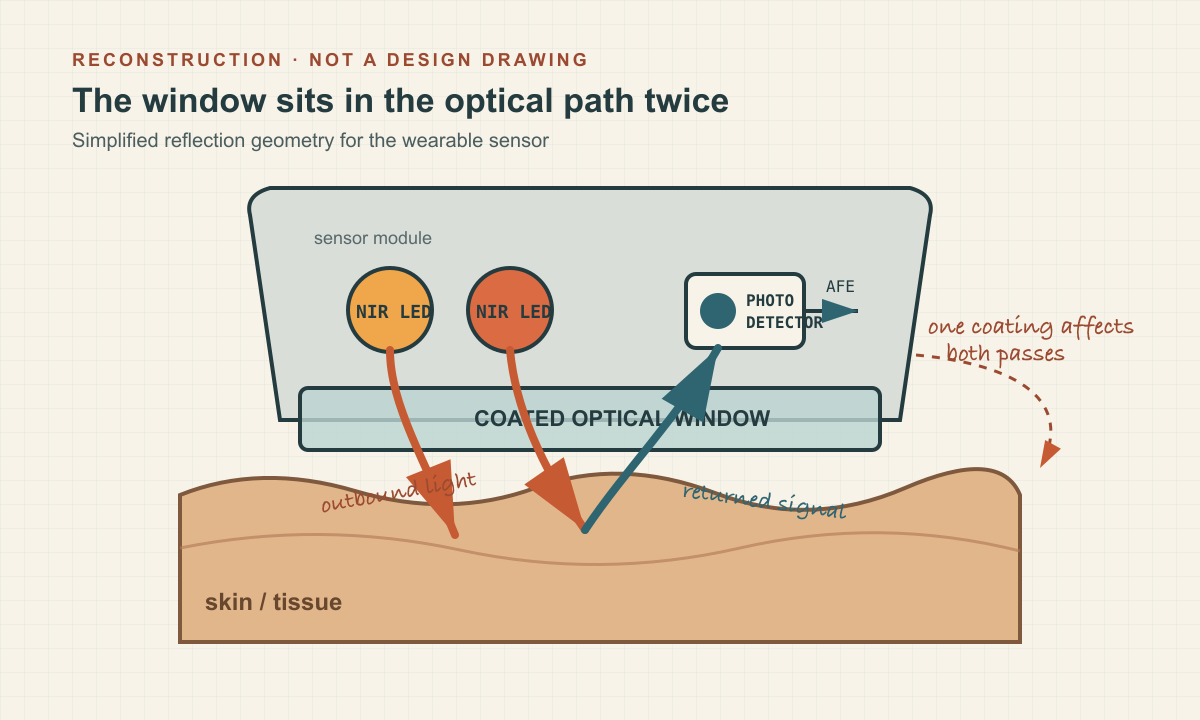
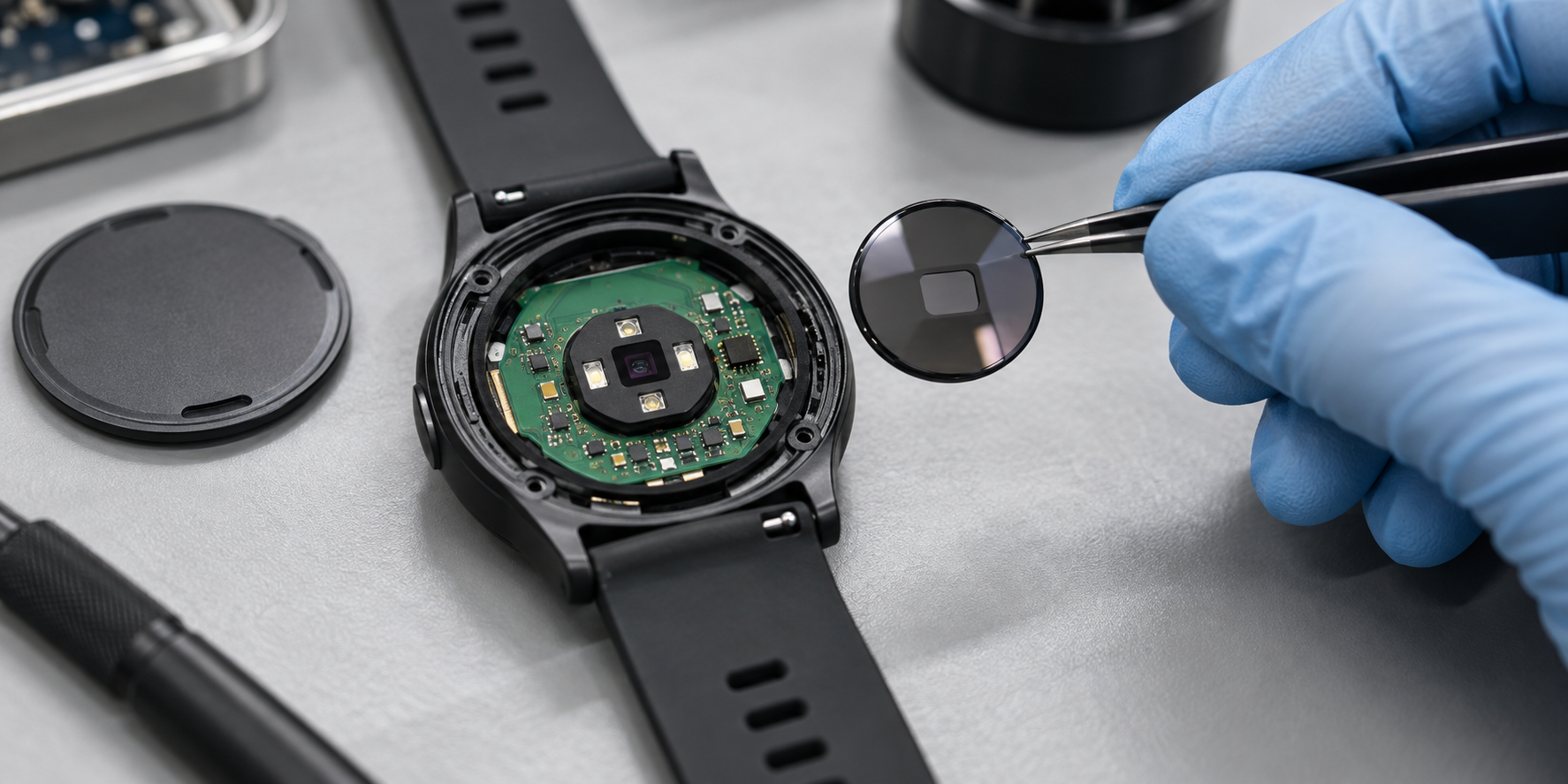
In this program, near-infrared light had to pass through the same coated window on the way into the tissue and again on its return to the detector. The window was therefore not cosmetic enclosure trim. It was a functional part of the sensing system—twice in the measurement path.
Engineering principle: If a component sits in the signal path, its transfer characteristics belong in the product specification and production-control plan.
The symptom: production readings no longer matched the prototype
The difference appeared when early production data was compared with the prototype build. Several causes remained plausible: emitter variation, detector response, assembly differences, calibration, mechanical contact, software behavior, or the optical window.
The team first contained the risk by pausing the remaining build. Engineers then reproduced the existing measurement workflow, including device connection, calibration, user settings, data refresh time, and dashboard review.
Collecting more units confirmed that a difference existed, but it did not isolate the cause. Every additional watch also introduced more variables: another PCBA, another assembly, another fit condition, and another calibration cycle.
The investigation needed a more discriminating experiment.
The decisive experiment: keep the device, change only the window
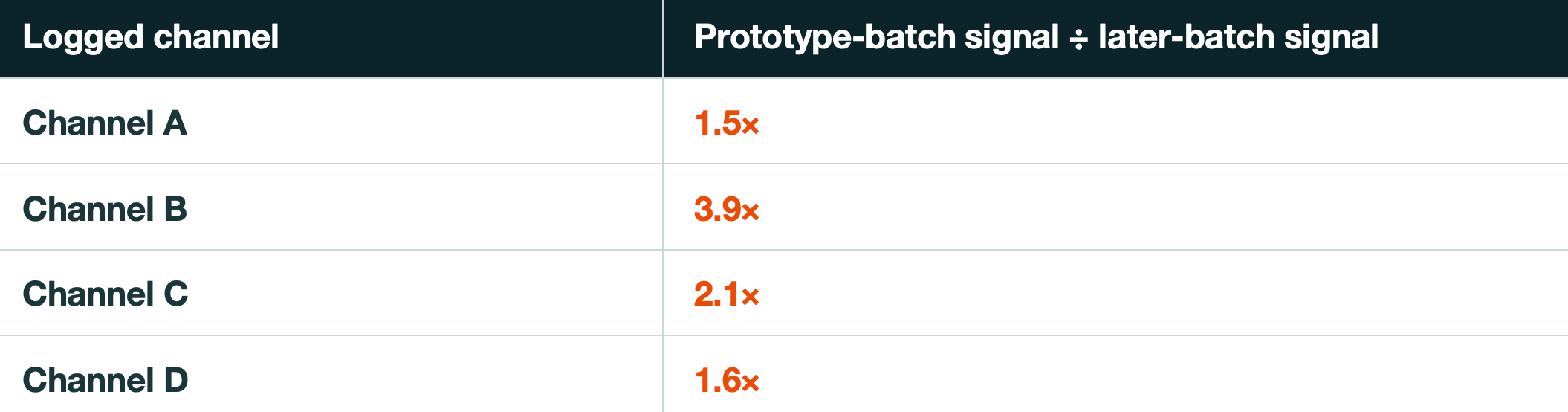
Engineers selected one watch and measured it with the later production window. They then replaced that window with a retained part from the working prototype batch while keeping the rest of the device unchanged.
All four logged optical channels increased:
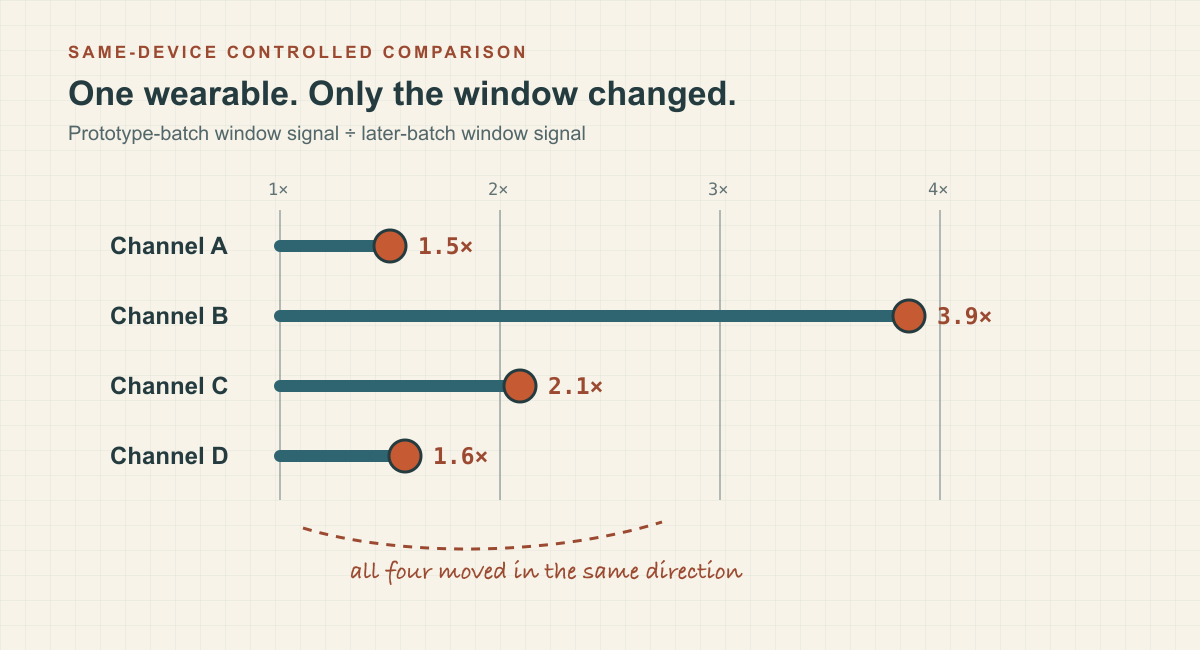
Reassembly can influence seating, alignment, contact pressure, and stray light. The team therefore treated the swap as strong isolation evidence and looked for independent confirmation before changing the production-control plan.
That is the practical distinction: a larger sample can describe the problem, while a controlled same-device swap can identify the next variable worth controlling.
Three independent lines of evidence converged

Independent spectral measurement
Third-party measurements showed that the later window batch transmitted less light across the relevant near-infrared region. The project review estimated a difference of roughly 10 percentage points across much of the 900–1500 nm range.
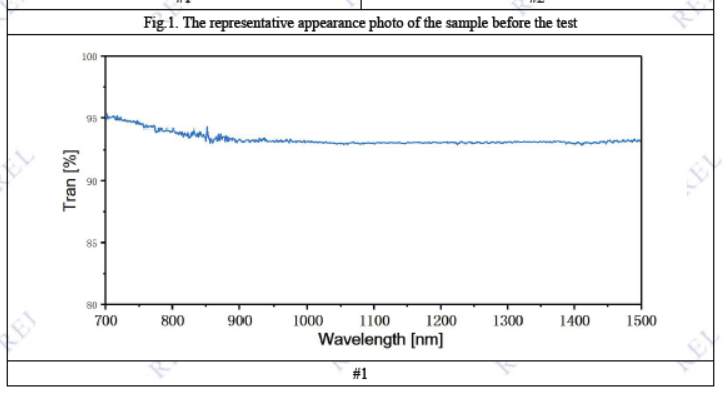
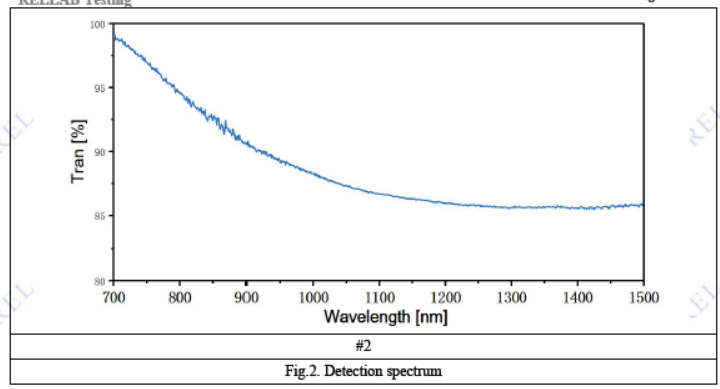
The roughly 10-point spectral difference was directionally consistent with the signal loss. Because the dashboard value sits downstream of LEDs, tissue, a detector, an analog front end, calibration, and signal processing, the transmission curve was used as material evidence rather than as a direct predictor of dashboard output.
Supplier process review
The supplier review identified a coating-process difference between batches. That connected the physical swap result and the spectral measurement to a plausible manufacturing cause.
Together, the swap test, spectral data, and process history made the window batch the leading explanation. The result was strong enough to guide containment while keeping possible reassembly effects in view during follow-up testing.
The manufacturing response: containment before optimization
The team prioritized material control before considering software compensation. Compensating in firmware could have hidden lot-to-lot variation and created a calibration dependency tied to the window batch.
The response focused on practical containment and prevention:
1. Hold the affected production flow. Keep risk contained while the evidence is reviewed.
2. Preserve golden references. Retain known-good windows and complete units from the build that worked.
3. Release replacement material against the full NIR requirement. Do not substitute visible appearance for spectral compliance.
4. Tie shipments to batch evidence. Require lot-specific transmission data rather than a generic coating statement.
5. Validate incoming inspection. Define the fixture, calibration, geometry, sampling, limits, traceability, and response plan.
Purchasing a light source or spectrometer does not automatically create measurement capability. A production control only becomes real when the method is repeatable and connected to a release decision.
Five lessons for wearable startups and hardware teams
Specify the optical band, not “high transparency”
Visible appearance is not a reliable proxy for near-infrared performance. Drawings and supplier specifications should define the wavelength range, minimum transmission, test geometry, report format, revision, and lot traceability.
Keep golden material from the build that worked
Retained prototype parts made the same-device comparison possible. Without a known-good window, the investigation would have remained statistical and slower.
Change one physical variable before expanding the sample size
When electronics, firmware, mechanics, and human contact can all change the output, a controlled swap usually teaches more than another uncontrolled group of units.
Treat supplier-process changes as engineering changes
A supplier may consider two coating routes commercially equivalent. The sensor may not. Material, coating, adhesive, surface finish, and curing changes should be assessed against product function, not only appearance and dimensional fit.
Validate the complete signal chain before production release
For optical wearables, production readiness includes the board, firmware, window, mechanical stack, body interface, calibration flow, and data review. Each layer can pass separately while the assembled system underperforms.
What the investigation required across engineering and manufacturing
This problem could not be resolved through PCBA testing alone. It required coordinated work across the optical path, mechanical assembly, software workflow, supplier process, and production controls.
In this case, the investigation required NexPCB to coordinate:
- Electronics and optical-signal review
- Mechanical disassembly and controlled part replacement
- Reproduction of the application and dashboard workflow
- Cross-unit and same-device data comparison
- Third-party laboratory testing and supplier process investigation
-
Production containment, replacement planning, and future incoming-quality controls
That combination matters for compact health wearables, consumer wellness devices, smart rings, IoT sensing products, and other body-worn electronics because interface risks are rarely confined to one component or one engineering team.
Across a wearable project, the same evidence should flow into DFM, supplier controls, NPI, pilot testing, and production release. NexPCB supports teams across those transitions, from feasibility and prototype iteration through final assembly and scale-up.
Build Your Wearable Product with NexPCB
If you are developing a wearable device involving sensors, BLE connectivity, embedded processing, batteries, smart textiles, antenna design, production testing, or scalable assembly, NexPCB can help you move from prototype to manufacturing readiness.
We support wearable teams with PCBA manufacturing, sensor module assembly, test coordination, mechanical integration, production validation, final assembly, packaging, and pilot-to-batch manufacturing.
Contact NexPCB to discuss your wearable project and get a manufacturing feasibility review.

.png)