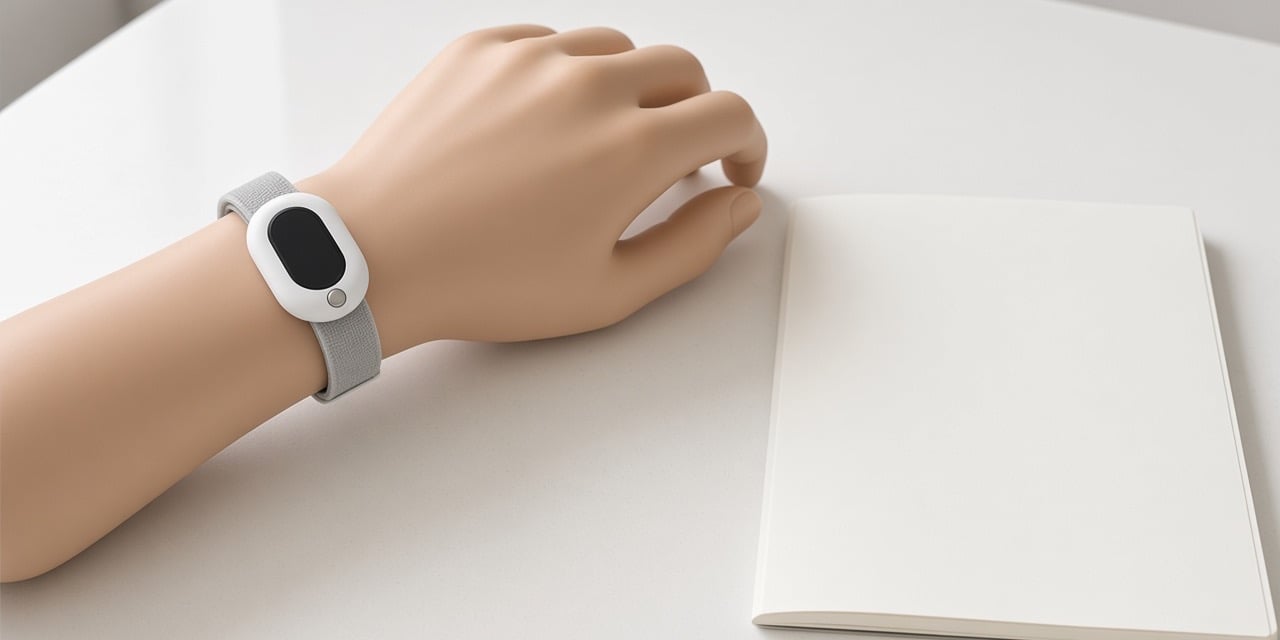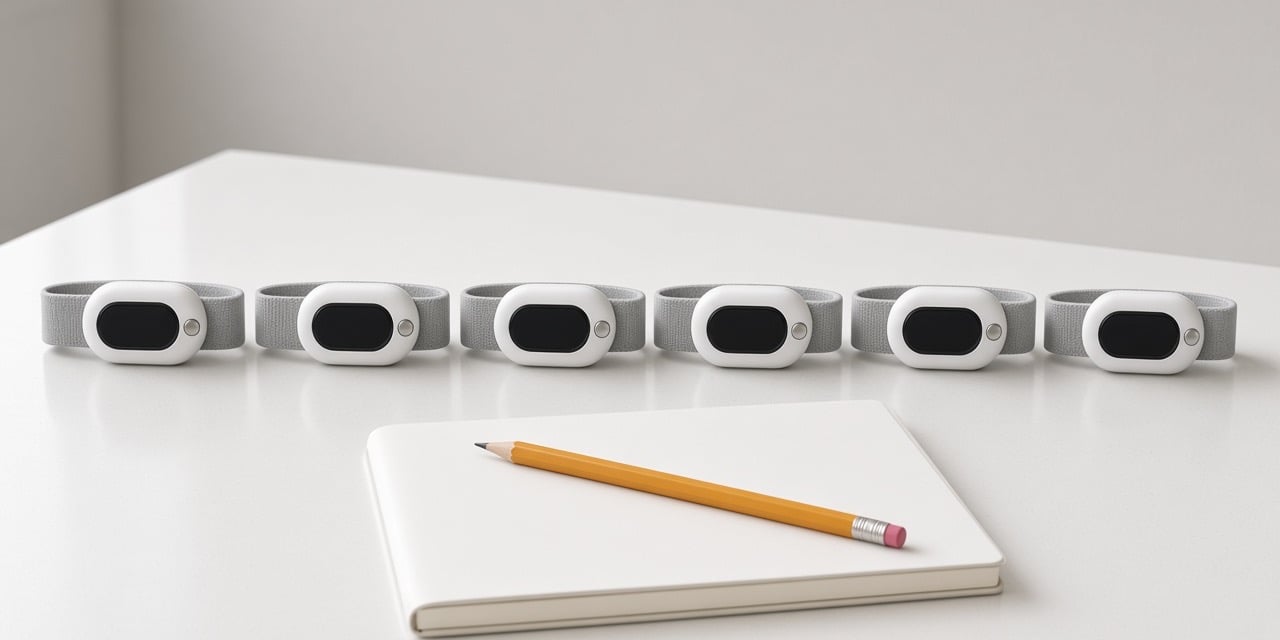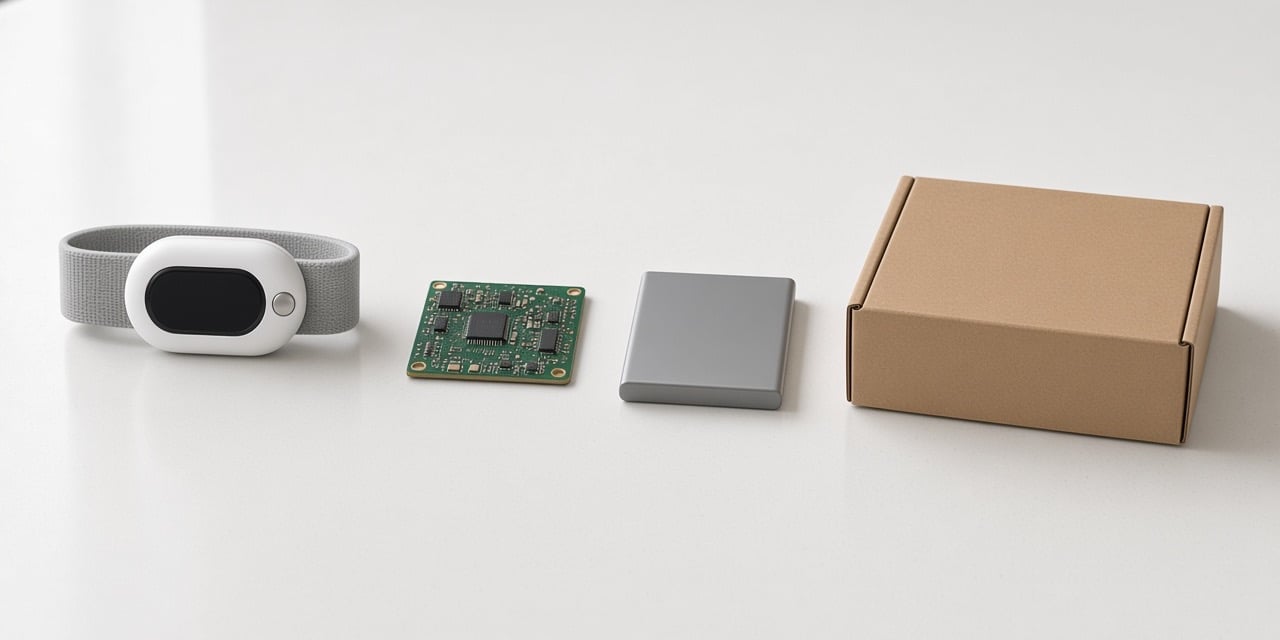
A wearable box build assembly at NexPCB starts when the housing, the populated board, the cell, the wear part, and the packaging are on the list. A populated board by itself is the input to the build. The pilot assembly starts when the structural parts, including the screws, are in, together with the board and the other electronic assemblies. Packaging can arrive after that start.
What the box-build process checks on the kit list
| Move | In hand before it starts | What that swim-safety wristband did |
|---|---|---|
| Subassembly | Board, cell, and contacts | Weld the cell, cure the coat for 24 hours, fit the shell spring contacts, solder the sensor pins |
| Final assembly | Housing, the waterproof strap, and the screws | Apply epoxy, clamp for 24 hours, close with screws |
| Whole-device test | The acceptance requirement that names a finished unit | Water check, then confirmation from the client for this project before pack-out |
On a swim-safety wristband the wear part was a waterproof strap, and the cell for the worn unit was chosen separately from the cell for the base station. Packaging followed the instruction from the client for this project, including the part numbers for the bubble bag or the shield bag, and a handover record was kept.
The work splits into three moves. Subassembly joins the board, the cell, and the contacts into something that can enter the housing. Final assembly puts that into the housing and adds the wear part, so it is one device. The test after that asks whether the finished device can do the action that project named. The bare board already had its own test.
Order review on that project recorded six dates: electronic material, the structural kit, quality, test and assembly, packaging, and the expected ship date. A blank date shows which input is still open. It is not a rule that any one blank date stops every kit.
The kit list is what has to be in the room. The sequence is the order that wristband was then built.
What the six order-review dates release
The six dates are when the electronic material arrives, when the structural kit arrives, the quality date, the test and assembly date, the packaging, and the expected ship date. On that review, the blank date is the input still open.
What the assembly sequence was on that wristband
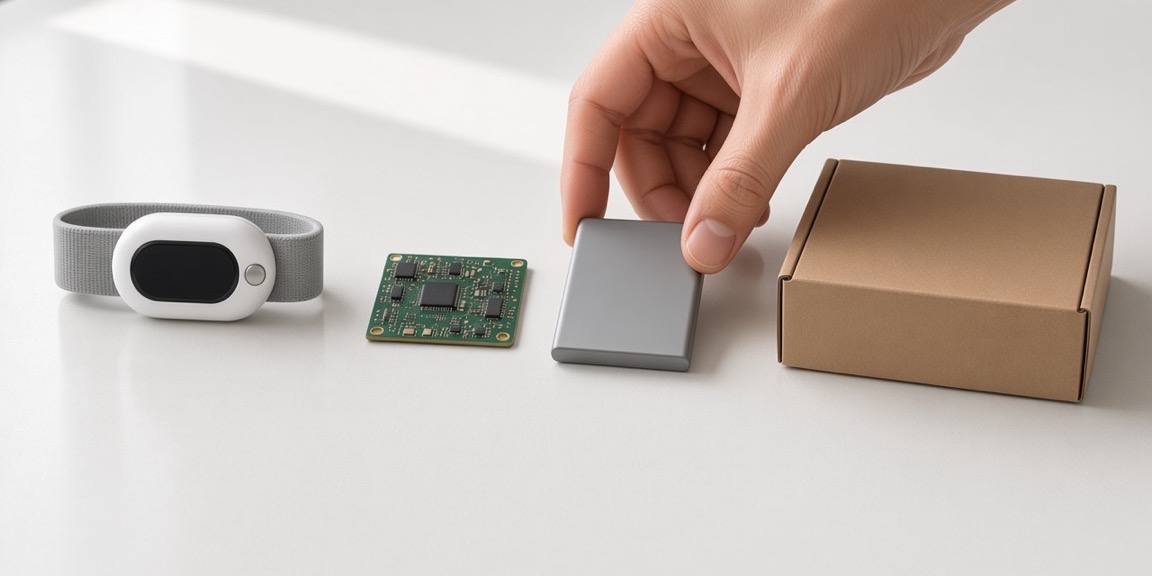
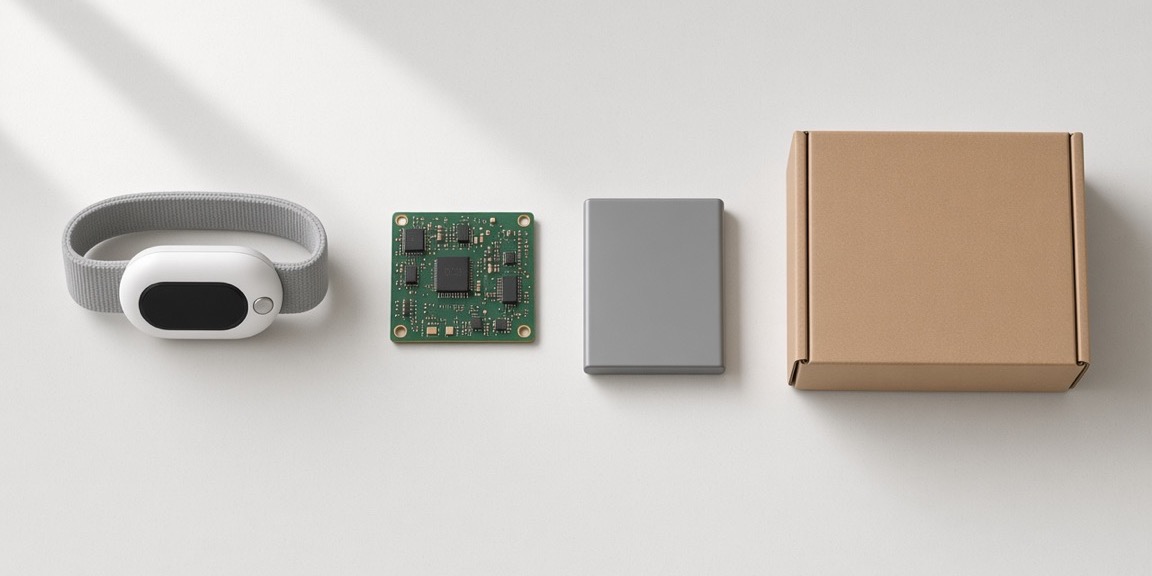
The parts in the photograph are a concept arrangement. They are not a teardown of that swim-safety wristband, and they do not show that project's board, cell, housing, and fasteners as they were assembled.
Each 24-hour wait is the cure that project used before the next joint. The coat cures before the contacts and the sensor pins. The epoxy cures before the screws.
Weld the cell. Let the conformal coat cure for 24 hours. Fit the shell spring contacts. Solder the sensor pins. Apply epoxy to the shell and clamp it for 24 hours. Close it with screws.
Once the screws are in, the seal and the function are checked on the closed joint.
What “finished” meant on that project
The same parts seen from above are still that concept arrangement. They are not the closed unit that project called finished.
Finished, on that project, was every functional test passed, the water check passed, and confirmation from the client for this project.
The water check had two steps, and neither step is an IP rating. A wet hand on the contacts had to move the reading from the dry baseline through the set threshold. After the adhesive, the unit was immersed for 30 seconds, blown dry with compressed air, and checked for function again. That 30-second check is a functional check after immersion. It is not the IP67 verification. The waterproof wristband, the complete worn electronic assembly rather than the strap material alone, was recorded at IP67. The base-station housing stayed at that project's target. On one project that target was IP62, and the client for this project left the extra tests off the list. IP67 and IP62 are enclosure codes in IEC 60529. The design file holds the code that project wrote down.
A watch program ended on the indicator being off, and that step belonged to that watch's test. It was not the only sign that the device was finished. Another watch was scored pass or fail on each function: cell voltage, accelerometer, flash, optical heart-rate sensing, and skin temperature. Any fail failed the unit. Pack-out on that batch waited until the client for this project confirmed the unit could be packed. Structural parts move to volume after the final assembly test on the builds that use that gate. Before that volume build we also look at interference, assembly tolerance, cosmetics, reliability under drop and water, and the quality standard handed over with the product. Interference and assembly tolerance are the checks that a part which fitted the pilot can still foul the housing once the quantity rises. They belong in the decision that the wearable is ready for mass production. The 24-hour cures and the cell choice stay with the wristband process that used them.
Frequently asked questions
Is the cell for the worn unit the same cell as the base station?
No. The two cells are chosen separately.
When does a watch count as a failed unit?
Any one failed function fails the unit.
What to bring to the first conversation
Bring the kit list, which cell belongs to the worn unit, what the wear part is, and the acceptance requirement you will use to call a unit finished. If a cure time, an immersion time, or a waterproof target is already written, send that as the project spec. Assembly notes come across after a non-disclosure agreement. Start at our project inquiry form.