At NexPCB, we use the stage boundary to ask whether the evidence from the work you just finished supports the next commitment. An electronics New Product Introduction (NPI) stage gate reviews the prior stage’s exit records against agreed conditions and records whether the next stage can start. A completed task list tells you work happened; the evidence tells you whether it answered the question the project needed settled. In a wearable hardware program, that distinction matters before you commit tooling or start to ramp.
Review the previous stage’s exit evidence
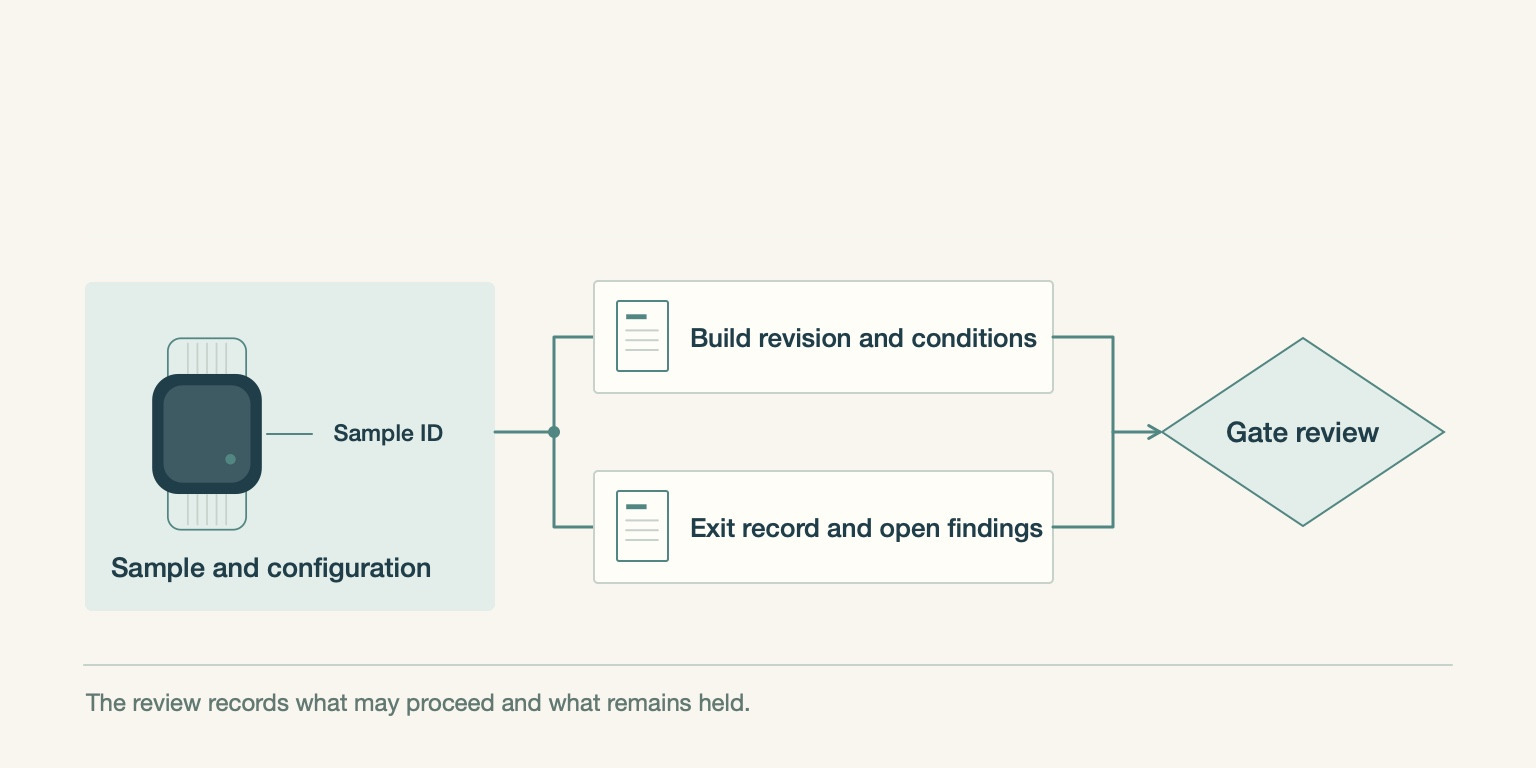
Begin with the decision you want the gate to make. If the proposed next action is NPI tooling, the evidence should address whether the configuration intended for tooling is established and whether findings that could change the tool have a disposition. “Pilot completed” is a schedule status. A pilot result tied to the design revision and the issue still open on that revision is something a reviewer can use.
Write the exit criteria early enough that the outgoing stage can collect evidence against them. Specify the approved requirement, the record that will show the outcome, and where the evidence applies. Where the record is a measurement or test, identify the conditions and configuration. Where the record is a design or manufacturing handoff, point to the approved version rather than a folder that contains several versions. Include findings that remain open and the effect they would have on the next stage.
Make the review decision usable
A gate should produce a recorded outcome, not a recap of the work. State the proposed entry stage, the evidence reviewed, the scope accepted, and any work held. If the evidence supports proceeding, record the baseline it supports. If a result is missing or the effect of a finding is unresolved, name the evidence that would permit the gate to reconvene. Where a project authorizes limited work, say what may proceed and what remains held so different teams do not act on different readings of the same meeting.
For instance, imagine a pilot produced useful test results on the latest electronics revision, but the fit evidence for the intended housing still refers to a previous revision. The team can preserve the valid electronics result and still hold the tooling action that depends on the housing interface. The review turns on whether the outstanding comparison can change the contemplated tool, not on whether most items on the checklist are complete.
Look at the evidence in the order the next decision needs it
A useful opening is the proposed entry decision and the outgoing stage’s accepted configuration. That gives everyone the same subject before the meeting moves into technical detail. Then read the evidence against the criteria that would change the decision. If a result applies to a different revision or operating condition, label it as context and identify what would establish applicability. That is more useful than treating it as either fully accepted evidence or something to discard.
Separate missing evidence from a result that failed an agreed criterion. A missing record calls for locating or collecting the evidence. A failed criterion calls for deciding how to address a known finding and what evidence will show the response was effective. Either can hold the next step, but they assign different work afterward. The distinction also makes the gate record readable: someone returning to the decision can see whether the question was unanswered or answered with an unfavorable result.
Match the evidence to the size of the commitment
The same record can support one decision and be insufficient for another. A prototype assembly might show that a proposed joint works under the conditions tested. To support a commitment to a tool that sets the joint geometry, the project may also need a released drawing and an acceptance requirement for that geometry. Ask what would be hard to undo in the next stage, then judge whether the incoming evidence actually addresses it. That question helps keep the gate focused when the outgoing stage has produced a large set of unrelated work.

Name the stages on both sides of the gate
Use the names on the Hardware Innovation Curve to identify the current and proposed next stage. On our curve, s0 is concept and design, s1 covers the initial prototype and prototype iteration, and s2 is the New Technology Introduction (NTI) pilot run. NPI covers s3 NPI tooling and s4 ramp-up. Volume production is s5 under Lifecycle Management. Separately from those stage labels, in practice we place engineering validation testing (EVT) in s1 and design validation testing (DVT) later in s1, before the s2 pilot run. Production validation testing (PVT) describes a manufacturing validation activity; it is not a named stage on this curve and does not rename s3.
| Proposed move | What the gate asks of the outgoing stage |
|---|---|
| Prototype iteration to s2 pilot run | Does the late-s1 design validation evidence support the specific pilot configuration and its test objectives? |
| s2 pilot run to s3 NPI tooling | Do the verified Control Book and confirmed Pilot Products support the tooling baseline, and have findings that could affect tooling been addressed? |
| s3 NPI tooling to s4 ramp-up | Does the tooling-stage evidence support the setup and acceptance conditions planned for the ramp? |
For the pilot-to-tooling boundary, our Engineering Acceleration (NTI) service identifies the verified Control Book and confirmed Pilot Products as NTI exit outputs. The Control Book records the design files, test specifications, process controls, bill of materials (BOM), and quality standards. At the gate, put the pilot results beside those requirements. If a pilot finding changes a revision or condition, identify how the agreed manufacturing package reflects that finding before it is carried into the next stage.
For the tooling-to-ramp boundary, use the agreed s3 criteria and the tooling evidence that answers them. A sample from a tooling trial can help confirm a particular condition; identify the tool and revision it represents. Where the sample leaves an issue unresolved, state how that issue affects the proposed ramp activity. Keeping the two stages explicit prevents a later record for one stage from getting mistaken for evidence that an earlier stage exited on the intended configuration.
Designate who decides whether the gate passes
Designate the engineer and the customer representative for the project and record their decision responsibilities. The engineer should be able to explain how the exit evidence addresses the agreed criteria; the customer representative should be designated to confirm the relevant decision for the project. Establish the decision authority at setup so the outcome is not left to an assumed role or a standing committee. The record should show who was designated and what they agreed could happen next.
How should you record an NPI gate decision?
Use the NTI-to-NPI handoff guide for the broader transition, and our eight checks for wearable mass-production readiness for examples of evidence and decisions at the pilot release review.
Save the decision with the version of the exit records reviewed at the gate. The next team needs that link when it encounters a later revision or a new report. If the gate is reopened, record why: a new result completed the evidence, a criterion changed, or the proposed next action changed. A new meeting date alone will not tell the team which part of the earlier decision is still applicable.
If the work is split across subsystems, make the dependency explicit. One team’s evidence may support starting an activity for its own scope while an unresolved interface holds another action. Name the interface and say which decision depends on it. Keeping the decision scoped this way lets each team interpret the gate without converting a limited approval into clearance for the full next stage.
Frequently asked questions
What is the difference between an NPI stage and a stage gate?
The stage is where the team does the work and collects results. The gate reviews the exit evidence from that work and records whether it supports the next named stage.
What happens when a required result is still open?
Record the requirement and the missing evidence, say which next action is affected, and state the condition for review. If the project authorizes other work to continue, record the narrower scope separately.
Can a stage gate authorize only part of the next stage?
If the project allows a limited decision, name the work that can proceed and the work still held. Record the evidence for each so clearance to start one activity is not read as approval for the full stage.
Prepare the next gate around one decision
Bring the stage you are exiting, the action you want to start, and the records that bear on that action to Accelerate Now. We can work through which evidence supports the proposed move and which findings still need a decision from your designated reviewers.